
Hitachi Ltd, Part I
Kabushikigaisha Hitachi Seisaku-sho
When Sega needed a CPU more powerful than the Zilog Z80, more powerful than the Motorola 68K, they chose the Hitachi SuperH. They used the Hitachi SuperH in the 32X, the Saturn, and the Dreamcast. This, of course, leads one to wonder: what in the world is the SuperH, and why did Sega choose it? Isn’t Hitachi a manufacturer of industrial equipment? Let’s find out.
Namihei Odaira was born on the 15th of January in 1874 in Ienaka, Shimotsuga, Tochigi Prefecture, Empire of Japan to Sōhachi and Chiyo Odaira. This was the Meiji era, and at the time of Odaira’s birth, the Japanese Industrial Revolution was well underway and Japan’s first hydroelectric generator was completed in Kyoto. In keeping with the times, Odaira’s parents insisted that their children be well educated, and that, as a matter of business practicality, their children learn English. Around the age of sixteen, Odaira’s father fell ill and passed away. Odaira’s older brother then left school to support the family and to ensure that Odaira could continue his studies.
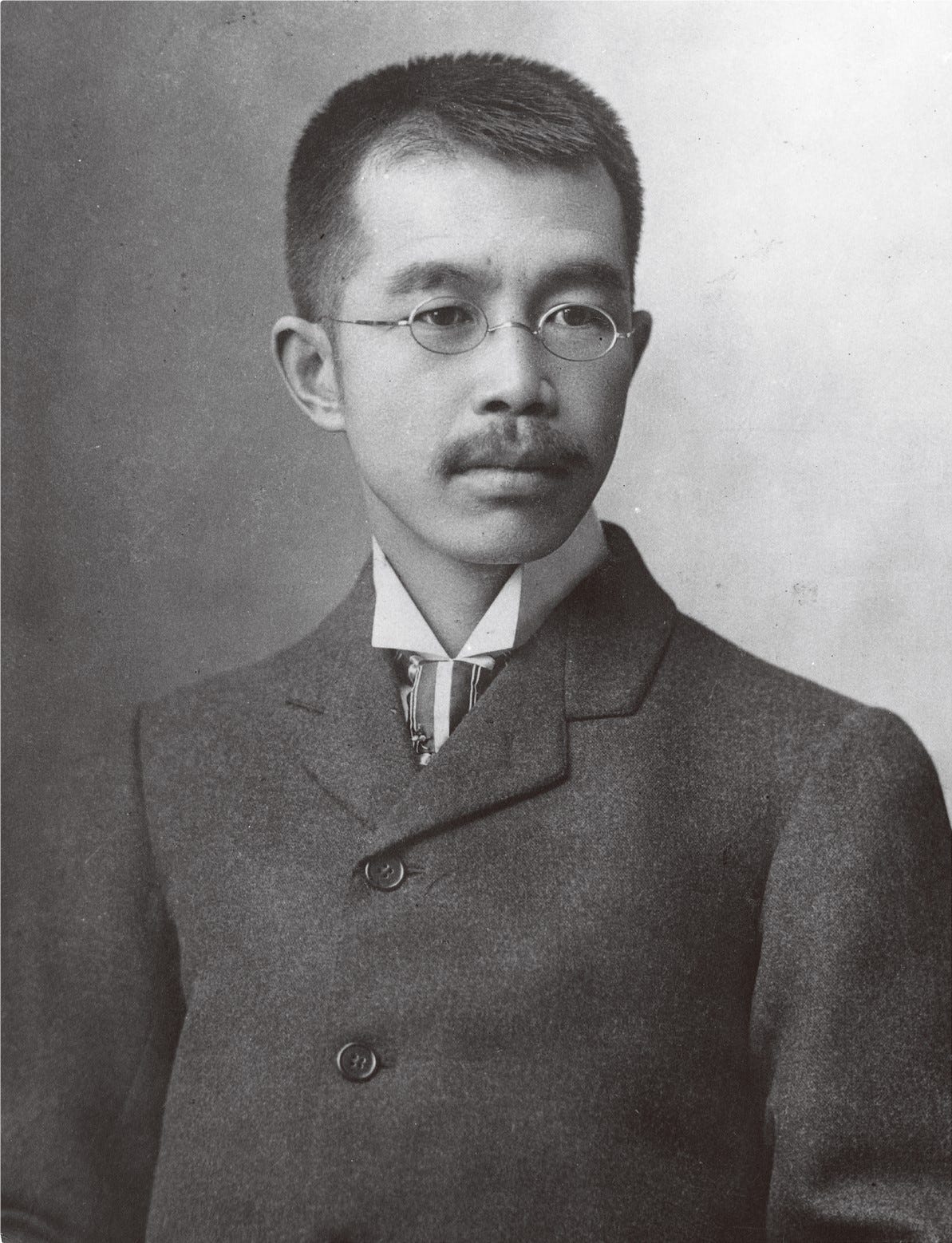
As he was completing his secondary education, Odaira felt anxious about his future. What should he study? At the age of twenty two, Odaira enrolled in Tokyo Imperial University’s electrical engineering department. He would have graduated after concluding his third year, but being young, he became absorbed by hobbies (photography in particular), and he had to repeat a year. He graduated at the age of twenty six in 1900.
The rise in electrification around the world meant a rise in copper mining, and those copper mines needed electricity themselves. Odaira was hired by Fujita & Co and assigned to the Kosaka Mine in Akita under the direction of mine chief Fusanosuke Kuhara. His first job was to serve as the engineering section chief, but shortly after he started in that position, Kuhara set him to work on a power station for the mine. He completed this task in just two years, and he was now convinced that electricity was the future of Japan. He left the Fujita zaibatsu and went to work for Tokyo Dento. This job had him working on power transmission equipment.
Kuhara contacted Odaira sometime in late 1903 or early 1904, and informed him Odaira of his intention to acquire the Akazawa copper mine in Hitachi City in Ibaraki. Kuhara wanted to avail himself of Odaira’s expertise and capabilities. Odaira accepted the job as chief of engineering, completed the Nakazato power station shortly after joining, and then went to work overhauling of the Akazawa mine’s machinery and facilities. In 1905, the Akazawa mine was renamed the Hitachi mine, and sometime shortly after Kuhara started the Kuhara zaibatsu and moved his various enterprises into it.
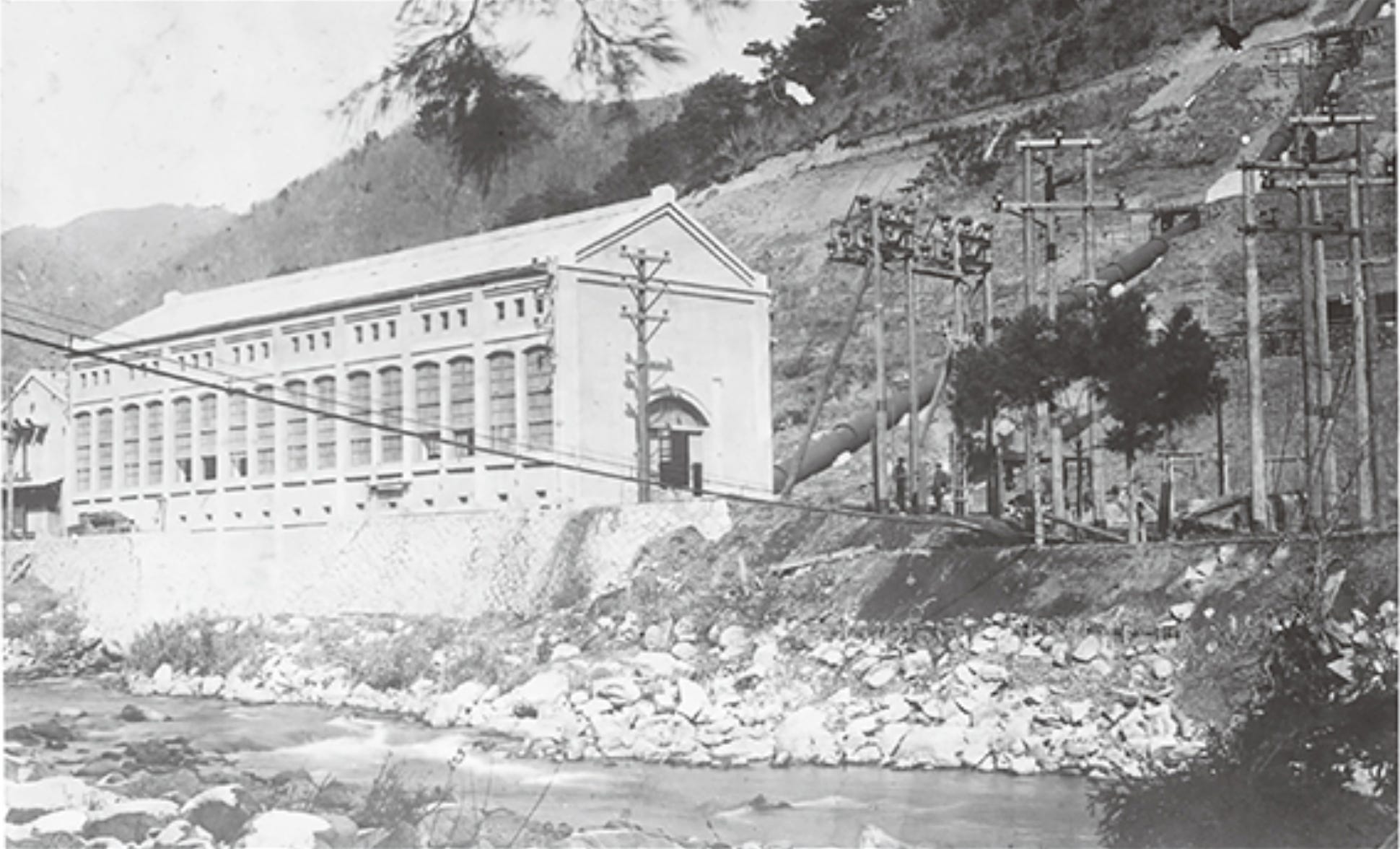
Largely due to the work of Odaira and his engineering team, production at the mine increased, and this brought about the need for even more power. The result was the design and construction of the 4000 kW Ishioka power station.
Odaira was likely a little obsessive. While working incredible hours for his employer, he and his team were also working on designs for electrical equipment. The first product of their research and design efforts was a 5hp/3.7kW electric motor completed in 1910. He took this to Kuhara, there was a brief debate, and Odaira was permitted to pursue the idea. Offices were finished that November, and a team of about four hundred was assembled. He chose to use the name Hitachi 日立 for this venture, combining the kanji for sun and rise (fitting for a company in the land of the rising sun), and it was a natural fit given the name of the city and mine.
Initial production was difficult, defect rates were high, and this spurred Hitachi to start an in-house training school. This helped, but after setting up a large generator for a customer resulted in another failure, Odaira established a formal equipment testing department, and a formal research and development department.
The company moved to Tokyo in 1917 only to burn down two years later. Despite the loss, this allowed Hitachi to become fully independent of Kuhara zaibatsu (which would later become Nissan) in 1920 as Hitachi, Ltd with Odaira as the managing director. On the 1st of September in 1923, an earthquake damaged Tokyo’s power grid and generation systems. Hitachi’s work in turning this around gained them social credibility and name recognition. The following year, Hitachi completed the ED15 electric locomotive, which combined with their recently received reputation, spurred orders from the Japanese government. Electric fans followed in 1926 and became the company’s first export. Those exports, however, were short lived with the arrival of the Great Depression in 1929. Odaira became the president of the company that year. In 1932, the company began producing elevators, and refrigerators. In 1939, the company built water turbines. As with most companies in countries involved in WWII, Hitachi was required to build for the war effort. This made their factories prime targets during the war. Odaira left the company in 1947 by direction of the US occupation. After the war, the company rebuilt yet again. In 1949, the company began producing construction machinery greatly adding to the country’s reconstruction efforts.
While Hitachi operated in many fields (electrical generation, consumer electronics, locomotives, nuclear reactors, auto parts), the rest of this article will focus on (mostly) on the company’s computing efforts.
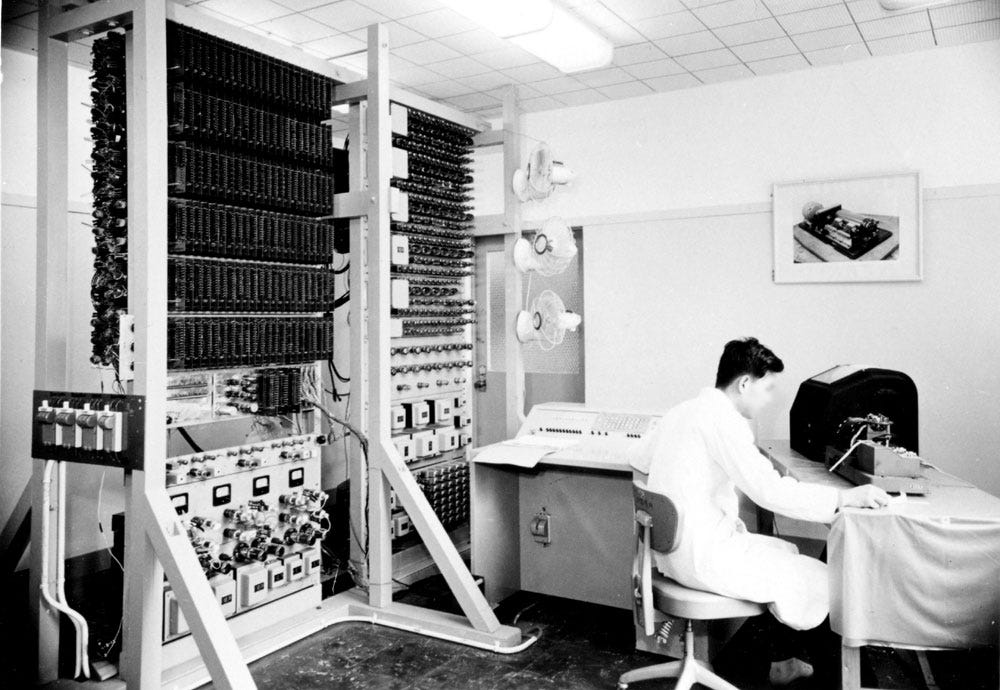
Hitachi began research into computing in 1951. The earliest work was in analog computers, and digital computing research began in 1956 with parametron logic. Why would a company that dealt in electrical power generation, construction, appliances, and mining be researching computers in the 1950s? Well, for Hitachi, knowing the exact sag and tension of power lines was rather important. For these calculations, the company completed the HIPAC MK-1 in 1957. The HIPAC MK-1 (HItachi Parametron Automatic Computer) was loosely based upon the EDSAC (and the ILLIAC to a lesser extent), but it was quite obviously different and original as it made use of parametrons. The MK-1 used magnetic drum memory, paper tape input (also used for system bootstrap), and could output to paper tape or a printer. The MK-1 performed its duties well and saved Hitachi quite a bit of time.
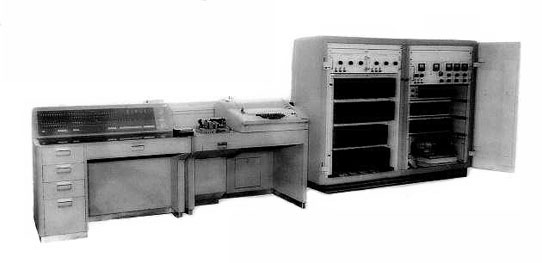
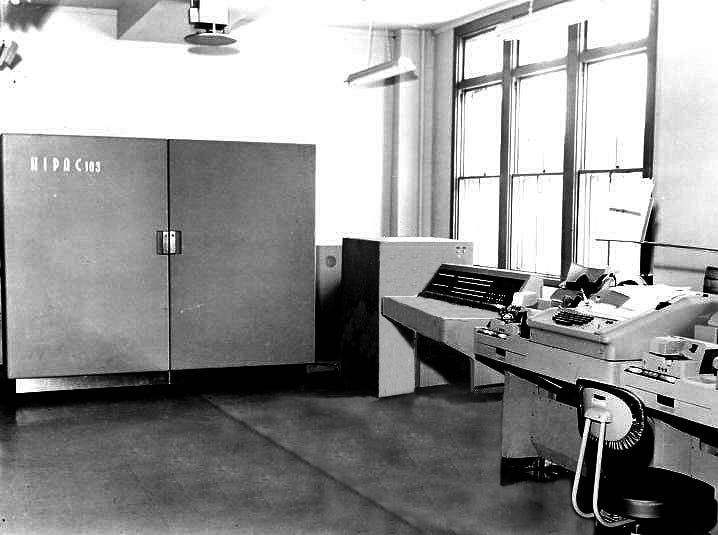
The MK-1 was good. Hitachi then enhanced it, provided standardized input, output, and housing for it, and displayed it at a computer exhibition in Paris in June of 1959. This was the HIPAC 101. Shipments of the machine began in July of 1960. An improved version, the 103, shipped in December of 1961. The updated HIPAC utilized core memory, 48bit words, with the capability to address 8192 words. It was exceedingly CISCy with 110 different types of instructions. It was capable of hardware floating point, and it shipped with FORTRAN. This was the final parametron computer from Hitachi. The most impressive bit, to me, reading about the HIPAC is that the mean time to failure was high. Even with the MK-1, it would seem that it ran for a solid seven hours for a single calculation. This is the kind of figure expected of fully transistorized machines, and even more particularly of machines that employed integrated components.
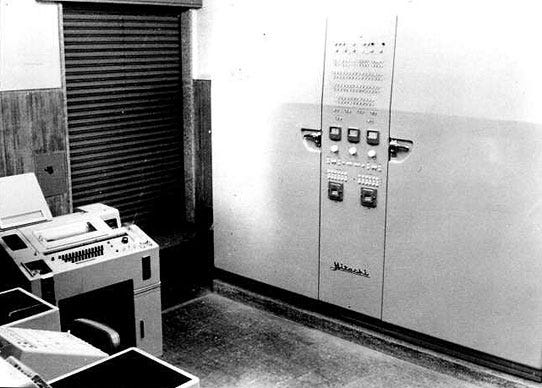
In the mid-1950s, a team at the Japanese National Railways’ Railway Technical Research Institute led by Mamoru Hosaka and Yutaka Ohno began designing logic for a computer that could handle seat reservations on a locomotive. This design was completed in 1958 and then given to Hitachi to implement. The machine, MARS-1 (magnetic-electronic automatic reservation system), was completed in July of 1959 at Hitachi’s Totsuka Plant by a team led by Yasuhiko Tani.
The MARS-1 was unique. The logic was implemented with 4500 diodes, 1000 transistors, and seventy vacuum tubes. Memory was provided by a magnetic drum that was just shy of twelve inches in diameter and another twelve inches in length spinning at 3000 RPM with 200 tracks. The drum provided 400,000 bits of main memory, and 1800 bits of register memory. CPU registers were provided by using the surface of the drum as a series of delay lines.
MARS-1 was used to figure out how the automation of the rail system would work, and MARS 101 took over the job in February of 1964. MARS 101 handled eight days of reservations, 127000 sets on 238 trains, their schedules, fares, and other important data. The MARS 101s across Japan were upgraded over time, and replacements came in the 102, 103, 104, 105, 201, 202, 301, 305, and 501 (this last entered service in 2002). The 103, however, was significantly different from its predecessors.
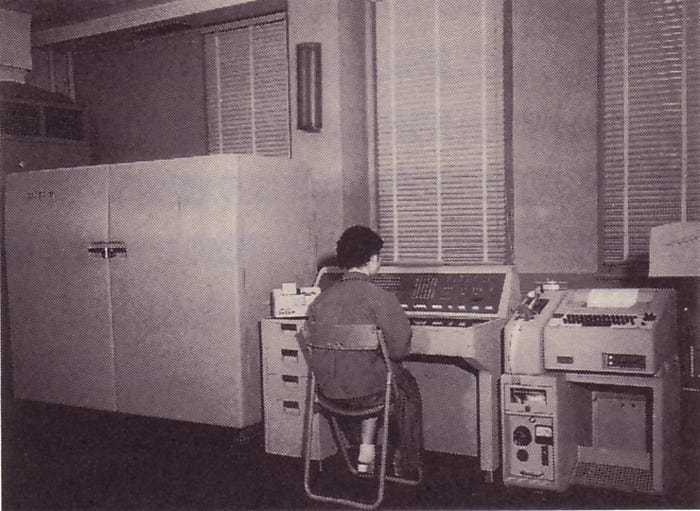
Hitachi had been working on transistor technology for some time, and the company’s first fully transistorized computer was completed in April of 1959 and delivered to the Japan Electronic Industry Development Association. This was the HITAC 301 and it was similar to the ETL Mark IV (junction type transistors, synchronous clock at 180KHz, magnetic drum of 1000 words) but it had a larger drum of 1960 words that rotated at 12000 RPM. The HITAC 301 achieved 3.4ms per addition, 4.8ms per multiplication, and 6.4ms per division. Importantly, where the HIPAC was intended for scientific and engineering purposes, the HITAC was intended for business processing work.
In 1949, Japan’s wartime asset freeze, which had prevented monetary flight throughout the Second World War, was lifted. At the same time, the Foreign Exchange Law came into effect with the goal of balancing international payments and stabilizing the country’s currency. A side effect of this was that IBM of Japan couldn’t make remittances to its corporate parent or to the IBM WTC. Some attempts were made both by IBM of Japan and by IBM WTC to ameliorate the situation but these efforts came to no avail. The solution finally came in Q4 of 1960 when the Japanese Ministry of International Trade and Industry accepted a proposal by IBM to license IBM’s patents to Japanese computer manufacturers and in return allow remittances to be made by IBM’s subsidiaries. Hitachi was among the very first Japanese companies to take advantage of this new arrangement along NEC, Fuji Tsushinki Seizo (Fujitsu), Oki Electric, Tokyo Shibaura Denki (Toshiba), Mitsubishi Electric, Matsushita Electric Industrial (Panasonic), and Hokushin Electric Works. Later licensees included Yokogawa Electric, Shimadzu, Shiba Denki, Sharp, Yamura Shinko, and Tokyo Denki Onkyo.
Despite Hitachi having been eager to get such an agreement, they didn’t immediately make any use of it. The next several computers used Hitachi’s own proprietary technologies, methods, and often enough materials (lest we forget that Hitachi was originally a mining technology company, then a construction equipment company, electrical generation, and everything else too).
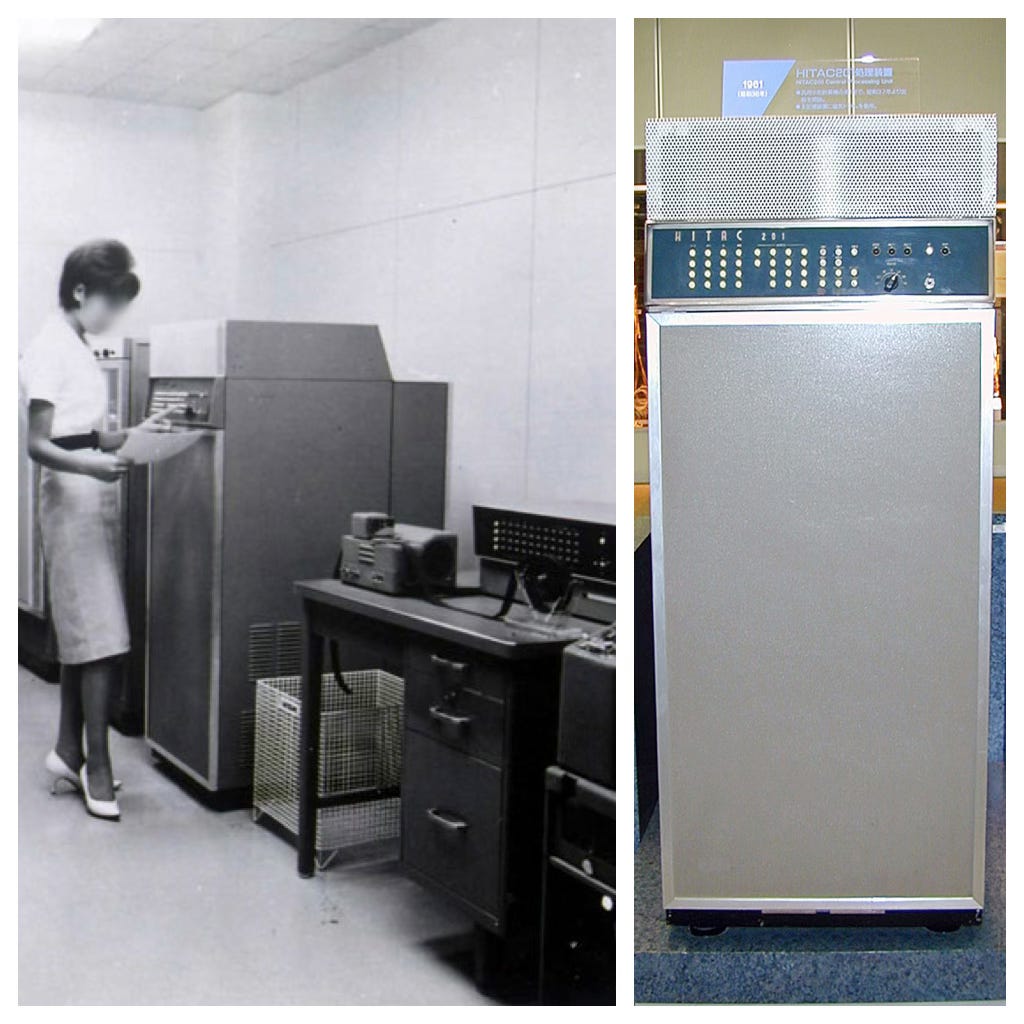
Of course, the 301 was really only affordable for large enterprises, and this left a market niche unaddressed. That niche was filled by the HITAC 201 which was completed in March of 1961. The 201’s development differed from most other computers at the time by having the goals set largely by the potential customers. Hitachi asked what was most important, and Hitachi’s customers responded with inexpensive magnetic tape drives, a kana-character line printer, at least 4000 word memory, and an instruction set suited for accounting systems. These goals were achieved. The HITAC 201 would ship with Hitachi’s second tape drive system (the first having been developed for the KDC-1 at Kyoto University), magnetic drum memory of 4000 words, paper tape reader, tape-punch, and a line printer capable of 120 lines/minute. The 201 could actually support up to four tape decks with each capable of 1000 digits per second with 300,000 digits per reel. As for computation, this was a fixed-point machine that used base ten, had thirty seven instructions, could perform additions in 4ms and mult/div in 30ms.
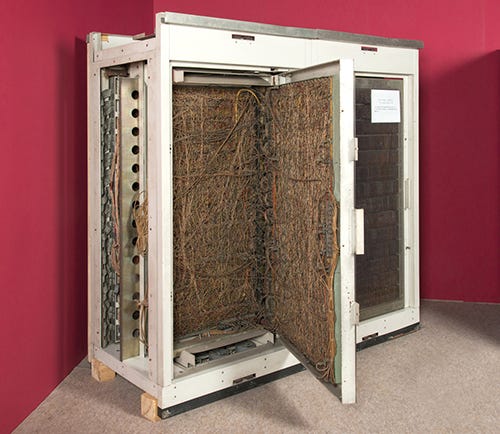
The Hitachi HITAC 5020 had begun development in April of 1960 by Kenro Murata and Kisaburo Nakazawa, and this would be a largely diode-based machine operating at about 18MHz. The first prototype was completed in May of 1963, and the first delivery was completed in 1965 to Kyoto University. It used core memory, delay line registers, and swappable cards made up logic elements (not too conceptually dissimilar from the cards made at DEC around the same time).
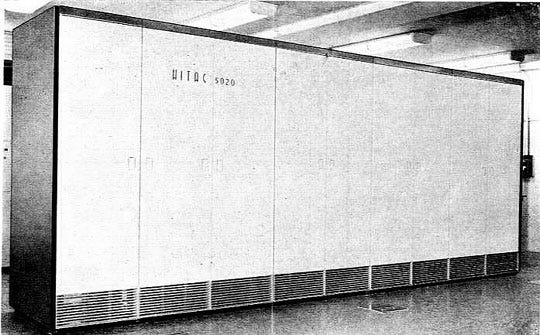
This was the first computer made by Hitachi to feature an operating system. This system, while primitive, was certainly a welcome addition. It featured a system monitor handling I/O and providing simple hardware abstractions, and a job monitor that would load and run each job automatically. It also included the MCP, or main control program, that acted as the scheduler and interrupt handler. The software package offered FORTRAN IV (optimized for the 5020), Autocode (enhanced with file controls, error handling, I/O buffering, scheduling, and macros), and a set of software libraries for common maintenance, operations, programming, debugging, and more. I cannot find as much information about this system as I could for SHARE, and if any reader knows more, please let me know.
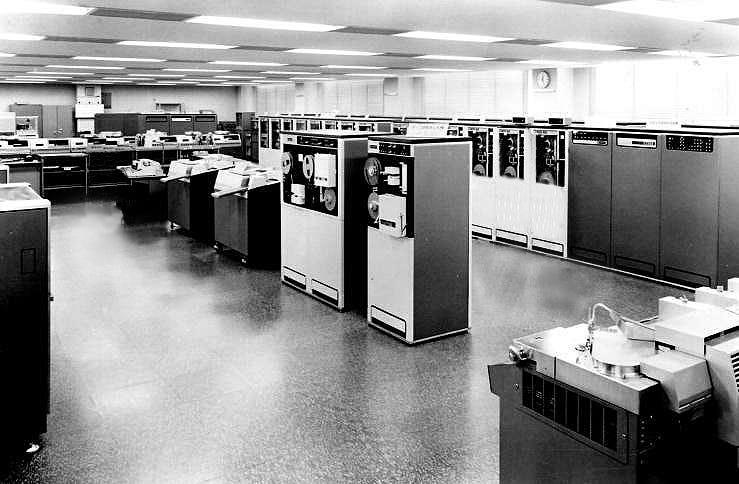
In late April of 1965, Hitachi announced the HITAC 8000 series of computers. These were based upon the Spectra 70 series machines from RCA, and were therefore ISA compatible with the IBM System/360. Like the RCA machines, the Hitachi computers came with a range of capabilities but were upward compatible such that software written for smaller machines would run perfectly well on a larger machine. The 8200 was the smallest, the 8300 and 8400 made up the mid range, and the 8500 was the largest. These were IC-based machines with standardized connectors, standardized I/O devices, and utilized an 8bit data format. This last part was vital for the Japanese market where kana was needed. This was also where the primary incompatibility with both RCA and IBM was found. While the English-language software could certainly be run on a HITAC and Japanese-language software could be run on a Spectra, it would require that all of the software libraries, printing capabilities, and so on also be present. These machines could run POS (Primary OS), TOS (Tape OS), and TDOS (Tape Disk OS) from RCA at the time of their introduction. Based upon these, however, Hitachi introduced DOS, EDOS, and EDOS-MSO. The latter of which was interesting for supporting batch, remote batch, and online processing at rather large scale and offering storage management and automatic file allocation for all three modes.

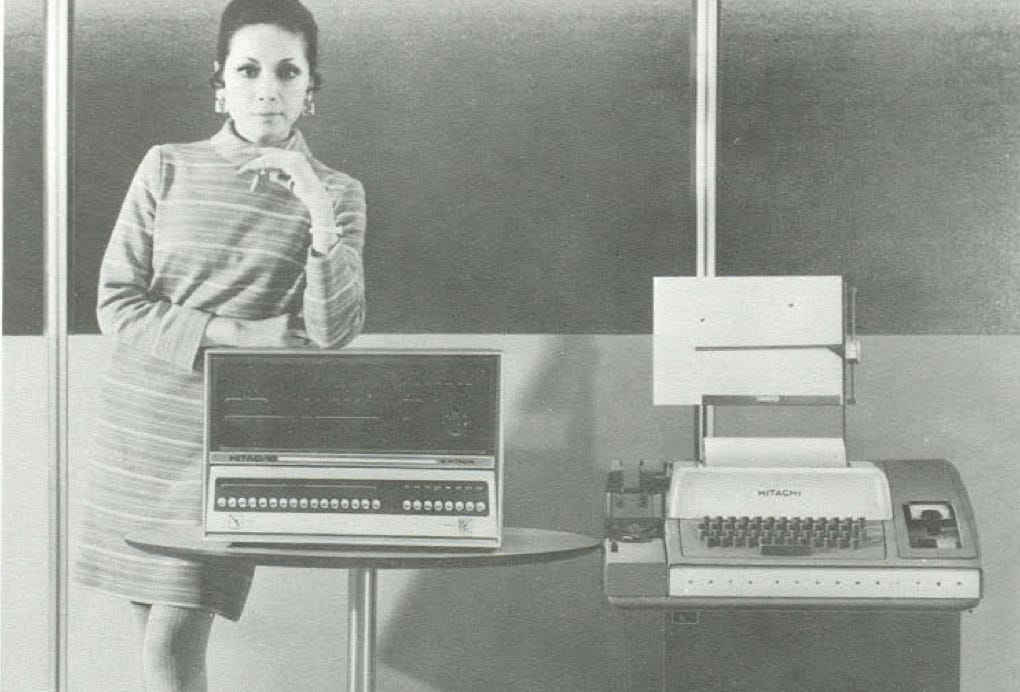
Hitachi was active in the minicomputer market starting with the HITAC 10 announced in February of 1969. This machine was mostly 16bit, and implemented entirely in ICs (except for memory). In its most humble configuration it featured 4096 words of core memory, but it could be configured with up to 32,768 words of memory. The HITAC 10 featured hardware multiply and divide, and featured up to sixty four I/O channels. The computer could be ordered as a rack mount unit or desktop, and it could make use of many other pre-existing Hitachi peripherals such as tape readers, memory expansions, card or paper tape punch, and so on. The software side of things was quite interesting because it reveals Hitachi’s thoughts about the computers use cases. The HITAC 10 shipped with a macro assembler, FORTRAN, a floating point arithmetic package, a set of mathematic subroutines, a debugger, and a premade calculator program. This minicomputer was clearly targeted toward scientific and mathematical environments, and not so much toward business.
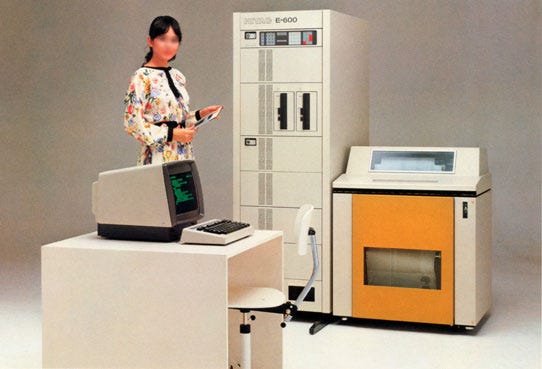
This machine’s successor shipped in 1973 with the HITAC 10II. Physically, it was half the height of the original, cycle times were reduced, and the machine gained support for BASIC. The target market had clearly and quickly changed. Two more updates were shipped, the 10II/A and the 10II/L which added IC memory and floppy disk support respectively. In 1975, Hitachi introduced the HITAC 20. This model’s CPU had more instructions, allowed for up to 256 peripherals to be attached, supported newer CRT consoles, and made communications controllers a standard feature. This made the machine popular as a network controller, and enabled remote connection to mainframes across Japan. This minicomputer was frequently the machine allowing terminals at bank branches to communicate to an off-site mainframe system, thereby greatly lowering the cost of computing in business settings. In the 1980s, the 10II was replaced by the E-600 series of minis, and the 20 was replaced by the E-800 series of minis. These were LSI implementations of higher performance with E-600 being 16bit with full backward compatibility and the E-800 being 32bit with M series compatibility. Both series were of the standard nineteen inch rack mount form factor.
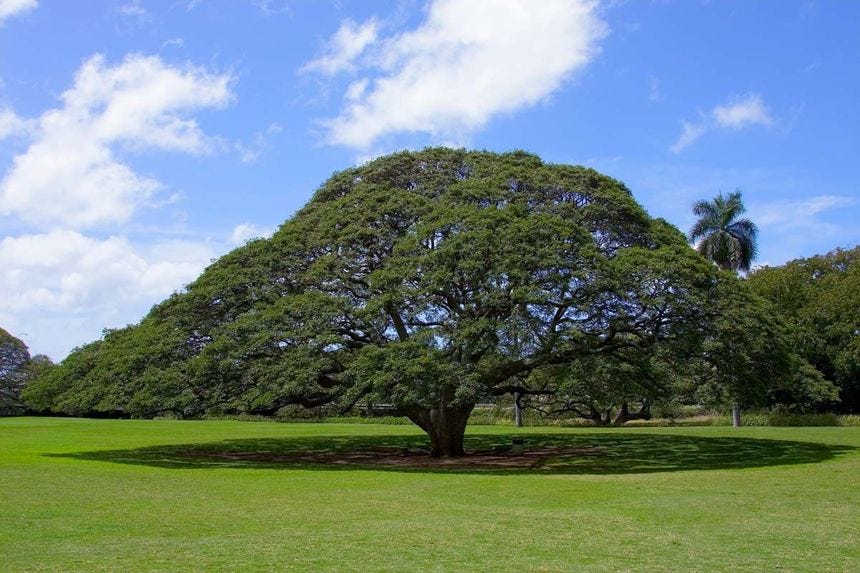
In 1973, Hitachi adopted a large monkeypod tree in the Moanalua Gardens as a corporate symbol. Hitachi promised annual payments of $20,000 to Damon Estate for exclusive rights to the tree’s image. The funds helped to maintain the gardens. The tree is protected by law by the county of Honolulu to this day. This particular monkeypod tree is known as the Hitachi Tree. More recently, John Philip Damon, president of Kaimana Ventures, purchased the gardens from the Estate of Samual Mills Damon for $5.05 million. A new contract was signed between Kaimana Ventures and Hitachi on the 28th of December in 2006. The new fee was $400,000 per annum and would last ten years. This was renewed in 2016. Hitachi seems to really love trees, and various Hitachi subsidiaries have dedicated themselves to protecting rainforests and planting trees around the world.
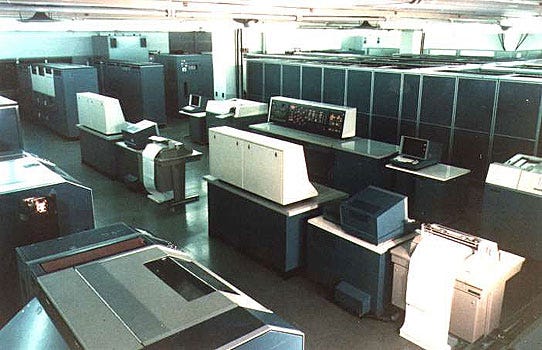
In 1970, RCA sold its computing division to Sperry Rand, and this forced Hitachi to once again chart its own route in computing. Funny enough, this wasn’t a problem. Three years prior, the Japanese government had funded a project to develop Japanese-designed and Japanese-manufactured high performance computers. So, in 1970, the company announced the HITAC 8700, and the following year, the 8800. These were available on the market in August of 1972, and they featured 32bit virtual addressing, multiple processors, pipelining, and buffered I/O with a dedicated I/O controller. The 8800 was one of the fastest computers available at the time, and offered up to 8MB of core memory. Both the 8700 and the 8800 were used for a wide variety of workloads including time-sharing systems.
To make these advanced computers easier to use, Hitachi developed OS7. This allowed for expansion via virtual memory, and swapping to a high-speed magnetic drum. Like the earlier 8000 series machines, the 8700 and 8800 could operate in batch, remote batch, and on-line interactive modes, but these machines could do so for multiple users and multiple programs simultaneously thanks to their advanced hardware coupled with OS7. The operating system was also aware of the multiple CPUs in the computer and could make accommodations for hardware failures so long as one CPU was still fully-functional. OS7 shipped with FORTRAN, PL/I, COBOL, BASIC, and an assembler. The standard utility suite for OS7 offered a linker, sort/merge, file and volume managers, debuggers, test data generator, batch job manager, terminal handler, symbolic and program library manager, math library, statistic library, graphic routines, and plotter routines.
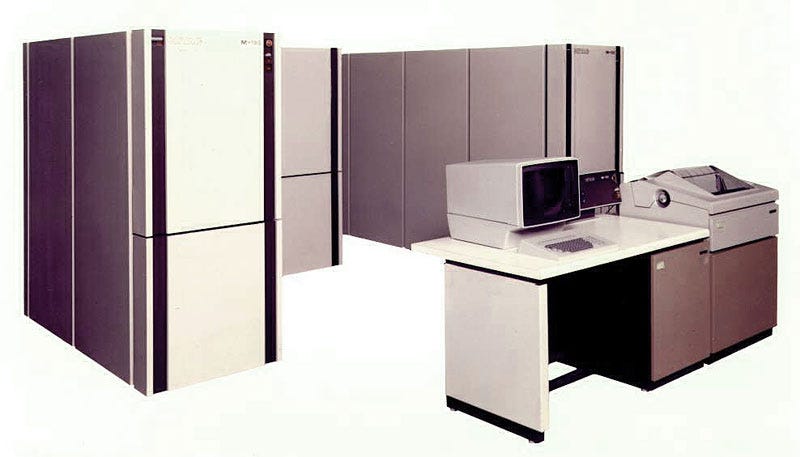
Development of the HITAC M series of machines began in the autumn of 1971, and these machines took advantage of the new technologies developed for the 8700/8800 including virtual memory, buffers, and the use of a dedicated I/O processor. These were descendants of the IBM S/370 compatible machines, but more advanced and proprietary to Hitachi. The high-end M-180 was announced in November of 1974. It offered two CPUs, up to 16MB of memory, up to 64K of buffer memory for 16 channels, an advanced ALU, and a dedicated array processor for vector calculations. The M-170 could be ordered with only a single CPU, up to 8MB of memory, and up to 32K of buffer memory for eight channels. The M-160 reduced the main memory to 256K to 4MB, zero buffer memory, and just five channels. The M-150 reduced main memory to just 1MB, and channels were reduced to four.
A quick note for those of you who’ve never dealt with mainframes of this era, a channel is comprised of a small processor (usually called a control unit) on its own bus to the CPU. It operates largely independently of the main system processor and can run a channel program (list of 8‑byte channel command words [CCWs]) that can read memory, write memory, address the I/O device on that channel, and then interrupt the CPU when necessary. This design frees the main CPU from having to handle every single event on a peripheral device whether that’s tape drives, hard disks, floppy disks, card readers, teletypes, terminals, or anything else and the CPU can just be made aware of whatever information is coming from the device or going to the device. So, the channel could fetch its own program from memory, interpret the channel commands, issue I/O requests, transfer data over its bus, and signal the CPU when it either completes a command or needs something from the CPU. As the channel handles the attached device, from the CPU perspective it is just sending things to a channel address rather than the device directly. This prevents the extremely expensive computer from sitting idle while handling some I/O event or waiting for data to return.
The HITAC M series were treated to VOS, or Virtual Operating System. Larger machines used VOS2 and smaller machines used VOS1. VOS2 supported virtual memory of up to 16MB, could processes up to fifteen jobs simultaneously, had more complete abstractions of the underlying hardware, supported backgrounding/foregrounding of processes, had a basic concept of permissions allowing for shared resources when specified, and had emulators for DOS, EDOS, and EDOS-MSO. In addition to those emulators, VOS2 shipped with an assembler translator from the 8000 series to the M series, and a COBOL converter for the same.
Smaller machines released by Hitachi in the early 1970s (and in particular the 8250) had used NDOS. By smaller machines, we mean those whose memory was somewhere in the 32K to 64K range. This enhanced DOS offered three main processing modes: single, continuous, and spool. It also expanded general capabilities in day to day use supporting console displays, interactive job control, and better disk space allocation controls. It continued the support of COBOL, FORTRAN, and PL/I but it also added RPG. The real-time functions of the system were enhanced, and better remote batch facilities were added (where the NDOS machine was sending a job to a larger machine such as the 8800).
The NDOS advancements were hybridized with features of VOS2 and this became VOS1. We see batch, on-line, remote batch, and remote batch terminal (the NDOS system) modes all present. Like NDOS, VOS1 supported COBOL, FORTRAN, RPG, and PL/I. VOS1 was more fault tolerant than NDOS with ability to reconfigure devices and flag bad memory/storage for avoidance. VOS1 was largely compatible with NDOS, but not as compatible with VOS2.
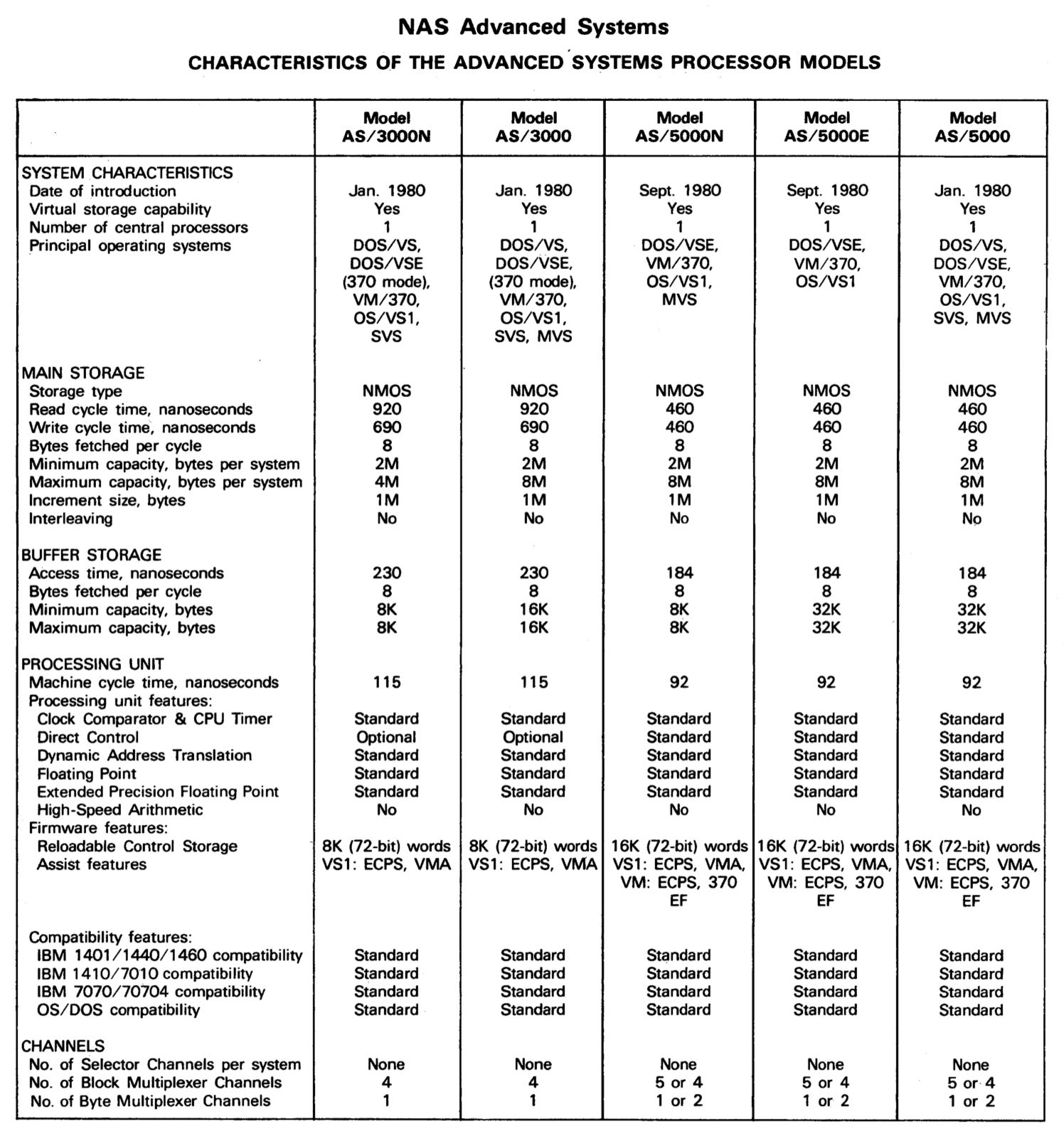
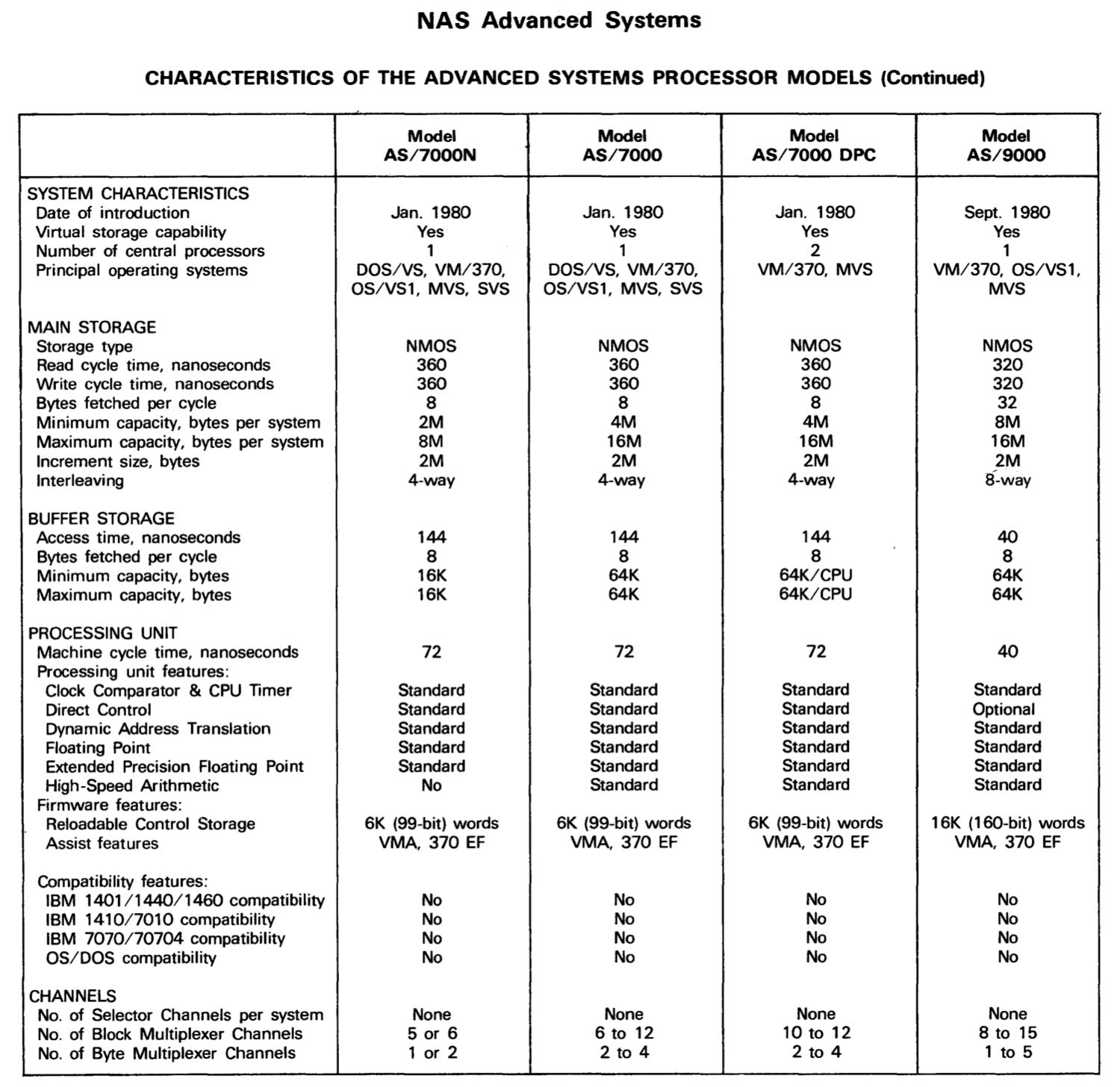
In 1976 in the USA, Itel Corporation began selling what were essentially clones of IBM mainframes 370/148, 370/158-1, and 370/158-3. The basic idea being to deliver systems that were equivalent in performance but at lower cost. This attracted quite a bit of attention. Hitachi and National Semiconductor formed a joint venture, National Advanced Systems, in Mountain View and took over Itel’s IBM clone business in October of 1979. This included the production, service, support contracts, inventory, and other assets and operations of Itel’s IBM-compatible business. They then released four new lines of systems named AS/3000, AS/5000, AS/7000, and AS/9000. All of these systems were compatible with System/360, System/370, 4300, and 303X software, and for the System/370, its features were replicated in hardware.
A key breakthrough at Hitachi was their Twin-Well Hi-CMOS process in 1978. Comparing the Hitachi HM6147 to the Intel 2147 on Intel’s HMOS, the Hitachi unit met the Intel’s performance at 87% less power consumption. The team that achieved this was led by Toshiaki Masuhara. Masuhara stated:
Mr. Yasui and I decided to develop the 4K CMOS SRAM. At that time, Intel was the top manufacturer of the high speed SRAM. And the part name was Intel 2147. We decided to develop CMOS SRAM, which was as fast as the Intel nMOS SRAM 2147 and has much less power and much less die area. Since we were using nMOS type polysilicon-load cell for the SRAM cell, the area was very small. They were contained in a single well. And we were using CMOS peripheral, so the power was much lower. I remember it was the year of 1977, we designed the circuit and we manufactured the device at Musashi works by using three-micron process. And we submitted the paper to ISSCC and that was accepted and we had the first paper in 1978. That was made into a project, actually a product later named 6147.
The work by this team proved to be among the most valuable to Hitachi’s computing efforts for the next ten years, for while most of the industry was using NMOS, they were using CMOS.


In September of 1978, Hitachi released the first home microcomputer of Japan, the MB-6880. This little machine was initially named the Page Master MB-6880, but was renamed the BASIC Master Level 1 to differentiate it from other models in the line. This computer was not actually developed by Hitachi’s computer division, but rather by the TV division as this wasn’t considered a serious computer. If anyone has information on precisely how this computer made it to market, I’d love to hear about it. Until we know for sure, I prefer to imagine that it was a drama fit for film.
The 6880 was built around a Hitachi-made Motorola 6800 at 750kHz, 4K RAM, and 8K ROM (featuring an integer BASIC). The display output was either 32 by 24 characters or 64 by 48 pixels. For mass storage, the computer could make use of a 300bps cassette interface. The very next year, the 6880L2 was released doubling the RAM and ROM and adding floating point.
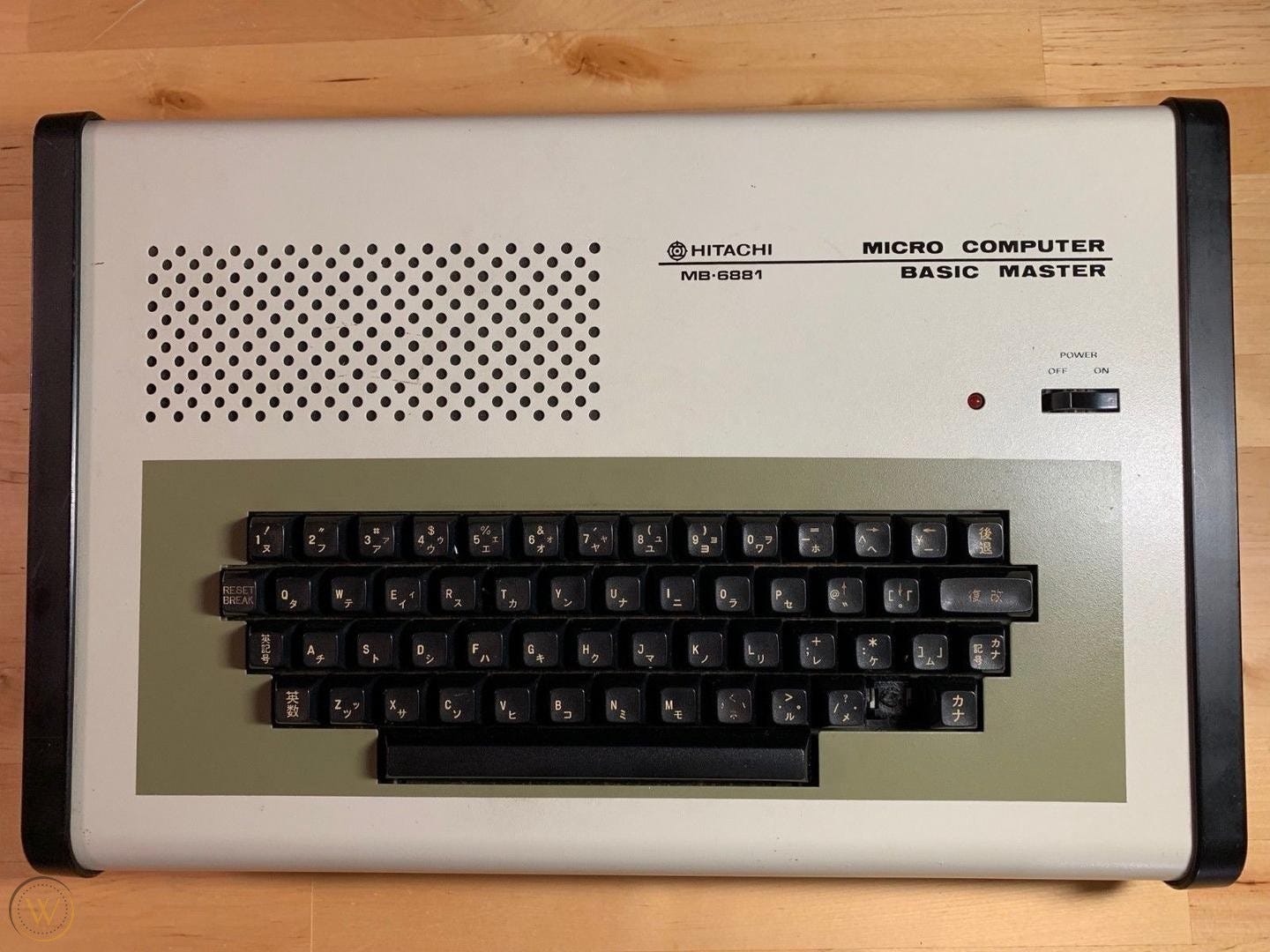
In 1980, Hitachi released the 6881, and here RAM is expanded to 16K and the price is lowered.


The final 6800 8bit from Hitachi was the MB-6885 or Basic Master Jr of 1981. This was a 16K RAM and 16K ROM unit with floating point capable BASIC. It also had dedicated VRAM allowing a resolution of 256 by 192 pixels, the PSU was integrated into the main computer housing, and had a cassette speed of 1200bps. Other immediately noticeable changes are the printer port and expansion port on the rear of the machine.
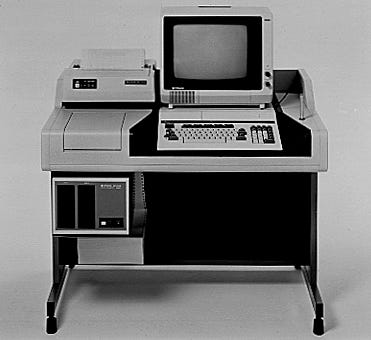
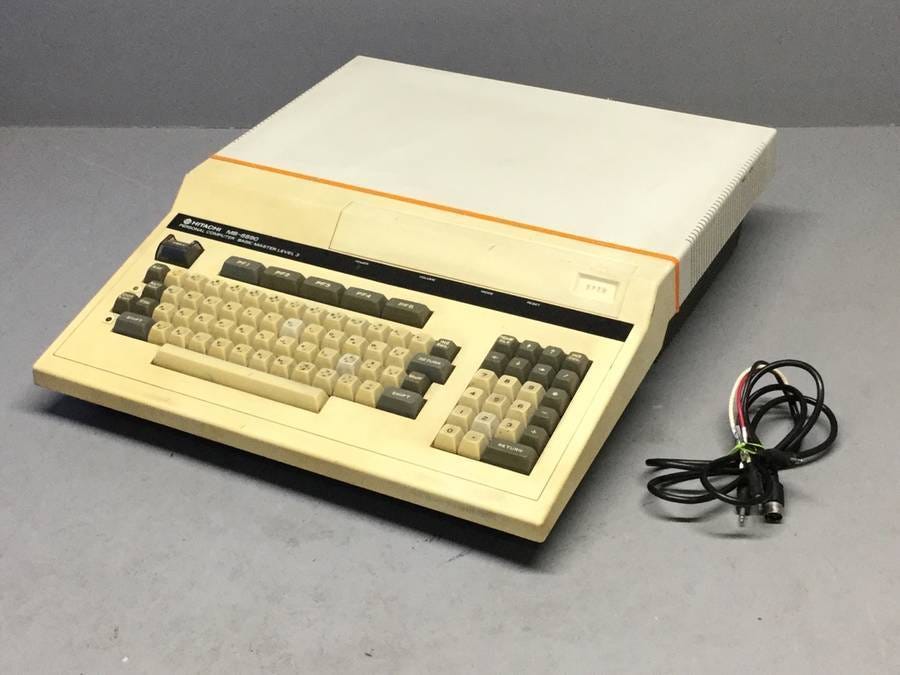
The sudden name switch to Basic Master Junior is due to the release of the 6809 based Basic Master Level 3 or MB-6890 in 1980. These machines shipped with Microsoft BASIC, and they had far more “professional” peripherals including floppy drives, color displays, printers, and so on. The 6890 was built around the Motorola 6809 at 1MHz, 32K RAM, 24K ROM, and could support a top resolution of 640 by 200 or 320 by 400 in eight colors. This machine also included six expansion slots. This was followed by the 6891 which increased the ROM size allowing for full kana support. The 6892 followed and increased RAM to 64K.
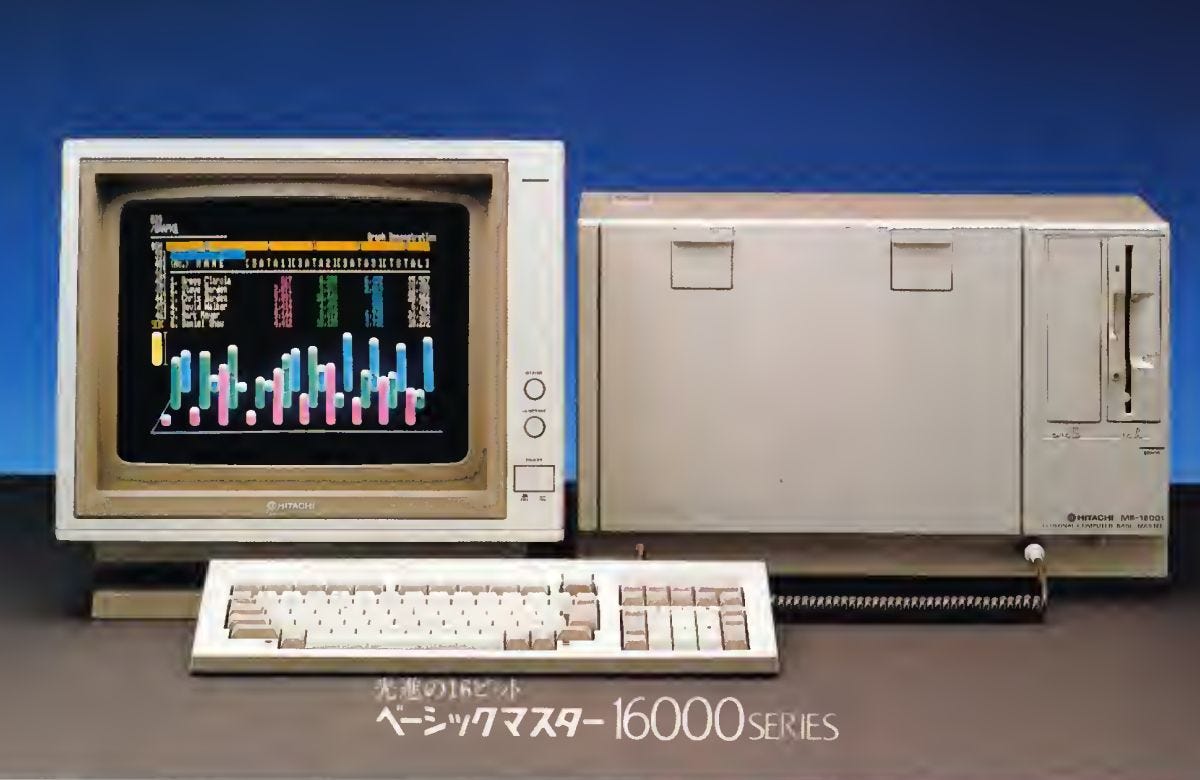
Of course, the world of microcomputers moves quickly. By 1982, an 8bit CPU was a low-end device. Hitachi then released the MB-16001 with an 8088, 320K RAM (expandable), and MS-DOS. This machine also supported color graphics, full kana, and kanji. As this was coming from Hitachi’s computer division who’d by this time realized that microcomputers were, indeed, real computers, the 16001 had FORTRAN and COBOL available.
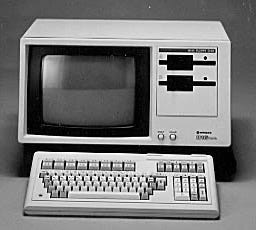
This, of course, is Hitachi. While they made computers, they also made pretty much everything else somewhere… so very similar machines were created for OA (office automation) and FA (factory automation). These were 8088 machines with RAM ranging from 256K to 512K with 5.25 inch floppy disk drives and 10MB hard disks. They were made available in 1983 as the B-16 range. The main feature to set these apart from anything else available was the software selection. I haven’t read of another computer sold with robotics routines and robot monitoring as standard.
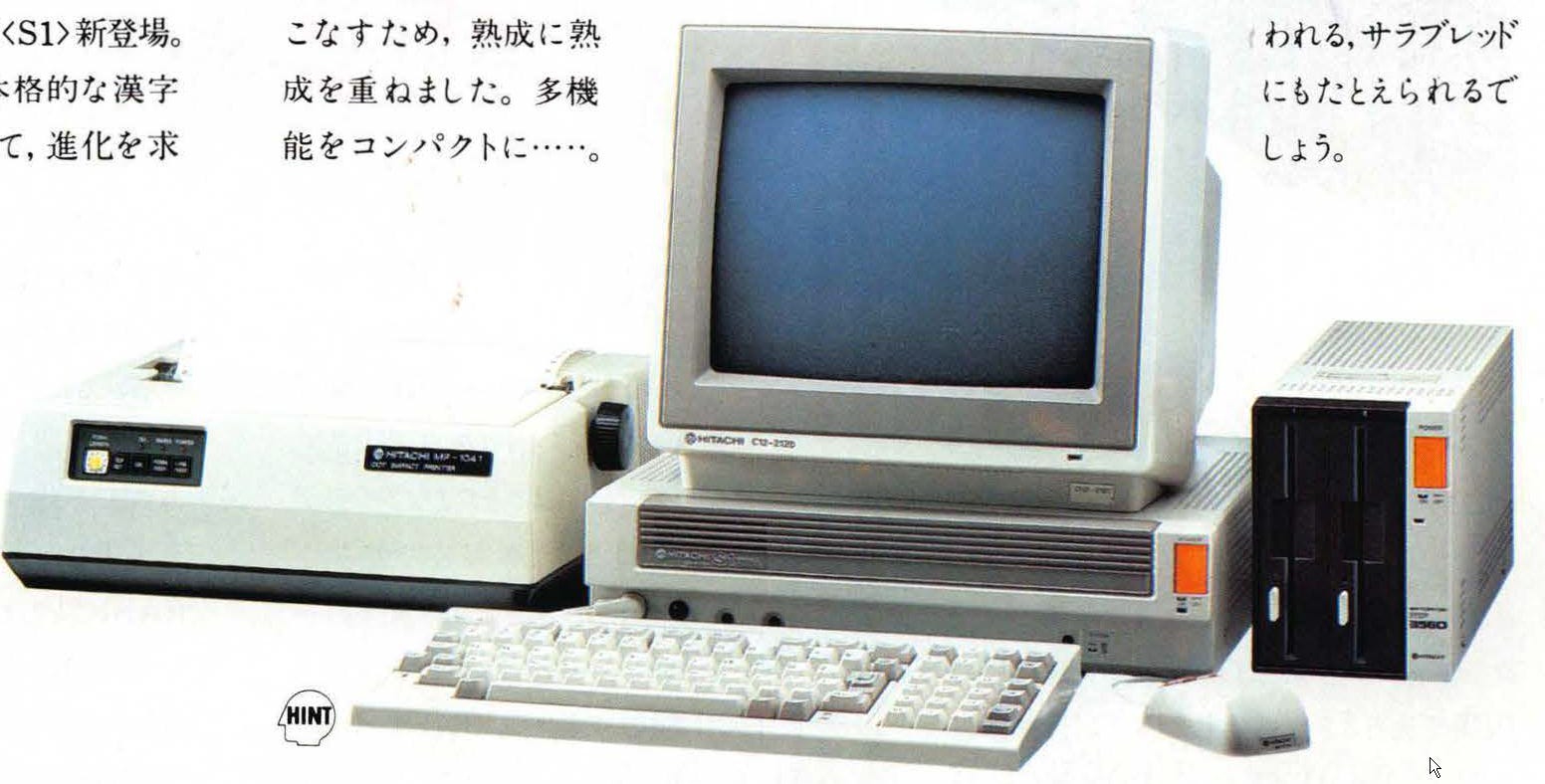
With many different machines capable of taking the high-end market, the Hitachi HD68B09E (Motorola 68B09) at 2MHz was used to create the MB-S1 series of computers in 1984. The S1/10 shipped with 48K RAM, 48K VRAM, and Microsoft BASIC. The form factor was now a desktop machine rather than the wedge, and the formerly expensive and high-end peripherals were quotidian. The S1/20 was essentially the same machine but added a ROM card containing kanji. The S1/30 and S1/40 were the next SKUs in this line, and these integrated the floppy disk drives into the computer’s housing, and these were higher capacity 1MB floppies. In 1985, the S1/10 was released as an S1/10AV adding six voice audio, and Atari-compatible joystick ports. The S1/15, and S1/45 took the 10 and 40 and added a communications ROM and an RS232C port.
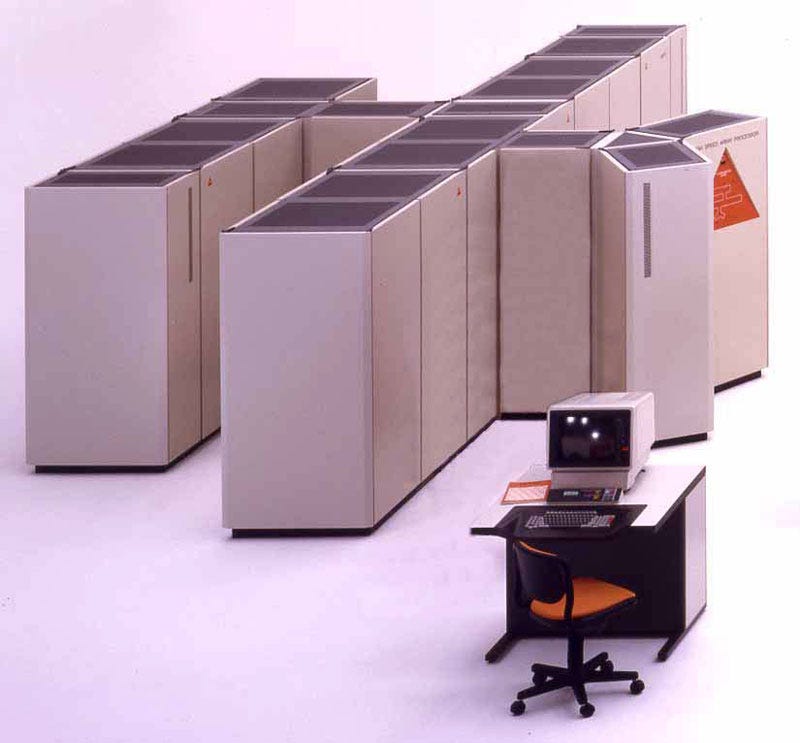
While Hitachi had been releasing small machines, the company hadn’t lost sight of the truly large machines either. In August of 1982, the company announced the second Japanese super computer, the HITAC S-810. This computer implemented the IBM System/370 ISA on the scalar Hitachi HITAC M-280H CPU at 35.71MHz with a 256K cache. The vector processor registers were 256 elements wide where each element was 64 bits, and the vector processor ran at 71.43MHz. Main memory was implemented in CMOS ICs, and could be up to 256MB. Expansion memory could be up to 3GB. Total performance peaked at 630 MFLOPS. Just five years later, the company would follow this with the S-820 offering performance up to 3 GFLOPS, 1GB of RAM, and 24GB of extended memory. The S-820 was the first supercomputer to have an integrated video output system as a standard feature.
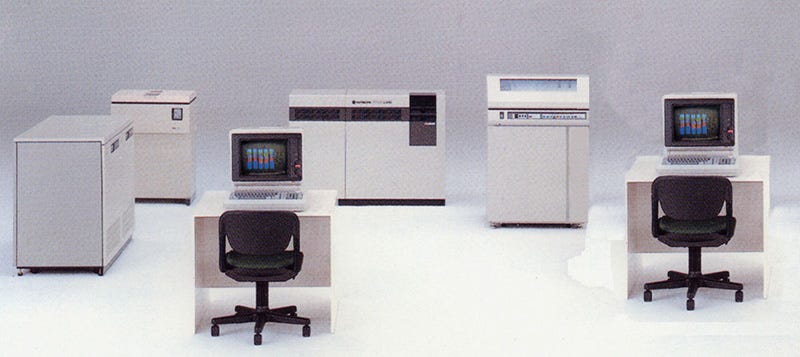
Both the mainframe and minicomputer HITAC brands continued with the L series. The L-470 and L490 were decidedly more mainframe-like while the L-450 could be order either in a mainframe-like form factor or “Desk-Type.” These machines were implemented in VLSI with 20k gates per chip in the logic circuits. Main memory for these machines could be up to 12MB and maximum disk capacities up to 5.4GB. The most amazing aspect of these machines was that they didn’t require any special power or air-conditioning considerations.
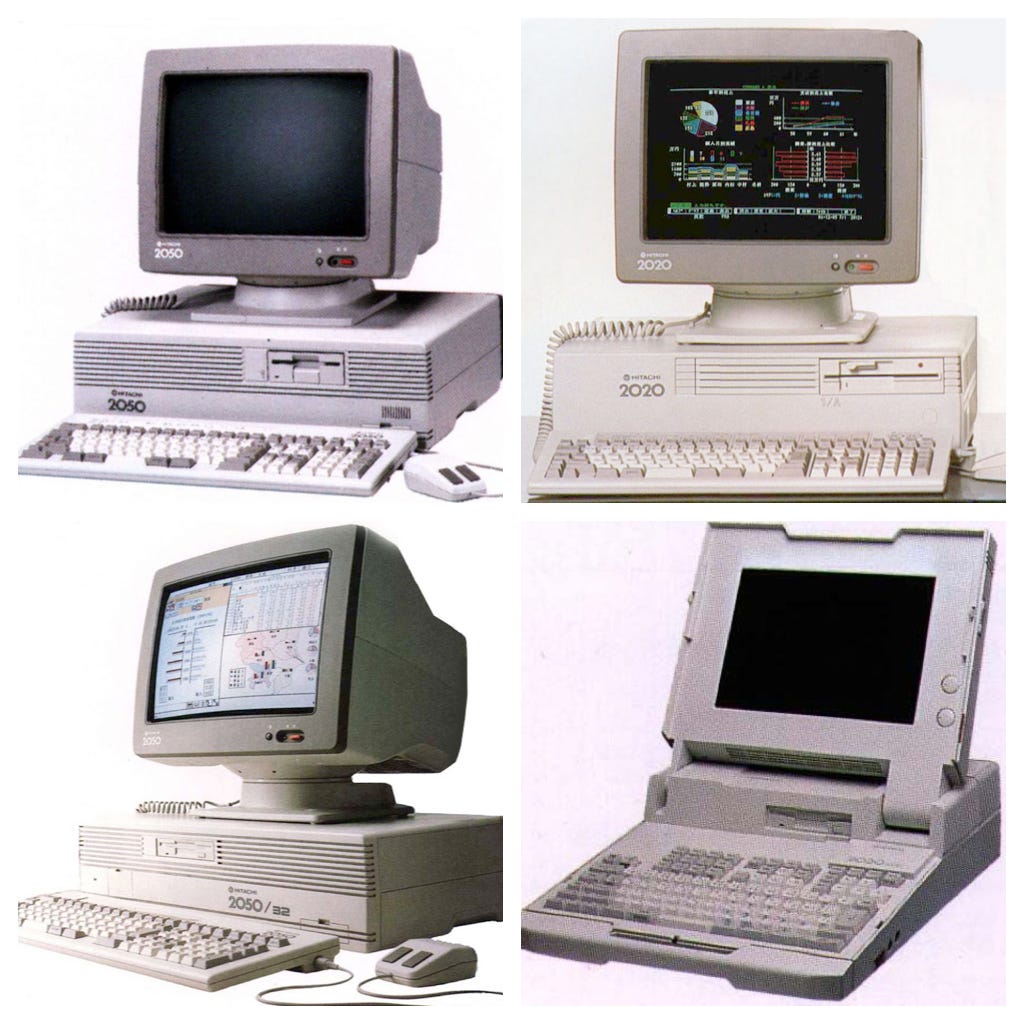
In September of 1985, Hitachi entered the UNIX workstation market with the Creative Workstation 2050 running their in-house HI-UX OS based on 4.2BSD. I’ve never used HI-UX, but it sounds like a great addition to the UNIX ecosystem. The OS added Japanese language support, defaulted to csh, had cross compilers for the 80186/80286 and Motorola 68K CPUs, and shipped with TCP/IP and ethernet support. There’s mention here of a “multi-window screen,” but I do not have much information on which graphics server was in use. In images of the 2050 series, a tiled window manager is clearly seen, but before the end of Hitachi’s workstations, HI-UX was using X11 with CDE. This UNIX lineage still exists at the time of this writing with HI-UX/MPP which makes use of the Mach microkernel. The IBM-compatible mainframe HI-UX releases are of a different lineage entirely coming from Interactive Systems corporation. For the hardware, the 2050 was built around the 68010 with 2MB to 4MB of RAM, 40MB to 65MB HDD, a 3.5 inch floppy disk drive, and either a 15 inch or 20 inch color flicker less, anti-glare treated, adjustable, CRT display.
Simultaneous to the release of the company’s UNIX workstation, Hitachi released a DOS-based workstation, the 2020, based around an Intel 80286, 1MB of RAM, one or two 5.25 inch floppy disk drives, a hard disk ranging from 10MB to 40MB, and a commodity CRT display of either twelve or fifteen inches with the buyer able to select either monochrome or color. For these, Hitachi didn’t ship commodity MS-DOS, but rather they shipped a compatible DOS that offered multi-tasking. I initially thought that this must have been Concurrent DOS. This would explain the presence of cross compilers on the 2050’s HI-UX port as well as DRI provided compatibility libraries for UNIX. This does not appear to have been the case. I have no reason to suspect that Hitachi ever had dealings with DRI, and Hitachi had extensive OS development experience. From everything I’ve been able to find, Hitachi made their own M68K port of UNIX System V release 2 with 4.2BSD, made their own multitasking DOS, and made their own compatibility libraries, cross compilers, and runtimes. If anyone has more information, let me know.
These lines were updated in May of 1988. The 2050/32 brought the 68020 at 20MHz with the 68881 coprocessor and 64K cache, up to 16MB of RAM, and an 88MB HDD. The 2020/32 brought the 80386 with an 80387 and 64K cache, up to 16MB of RAM, and an 80MB HDD. The 2050/32 was released in 1989 with a 68030 at 25MHz, up to 52MB of RAM, and a 168MB HDD. The 2020/32E was released in 1990, and was cost reduced (and physically smaller) with a 386SX at 16MHz, a 387SX, 4MB of RAM, and a 40MB HDD.
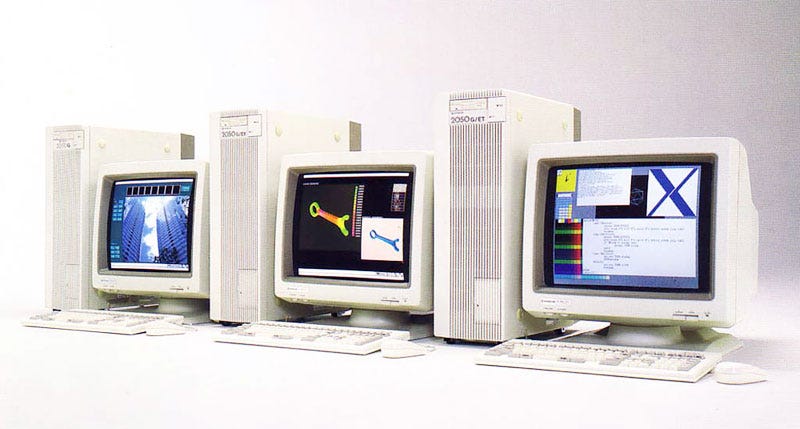
With the likes of SGI taking UNIX workstations into the world of graphics, Hitachi chose to compete. This brought about the 2050G in 1988, and the 2050G/ET and 2050G/EX in 1989. The 2050G was a machine built around the 68020 at 20MHz with a 68881 and 64K cache. The machine could be fitted with up to 16MB of RAM, a single 3.5 inch FDD, up to a 2.9GB HDD, and either a fifteen, twenty, or twenty six inch color display capable of 16.7 million colors and a resolution of 1280 by 1024 pixels. The rather high display specifications were enabled by a bespoke LSI chip for two dimensional graphics. The 3D performance was enabled via the same LSI, the 68882, and software. The G/EX used a 68030 at 33MHz with a 68882, increased the maximum RAM to 64MB, and added a RISC coprocessor that functioned as both a 2D and 3D accelerator. The ET was roughly the same as the EX but offered a larger 3.3GB HDD.
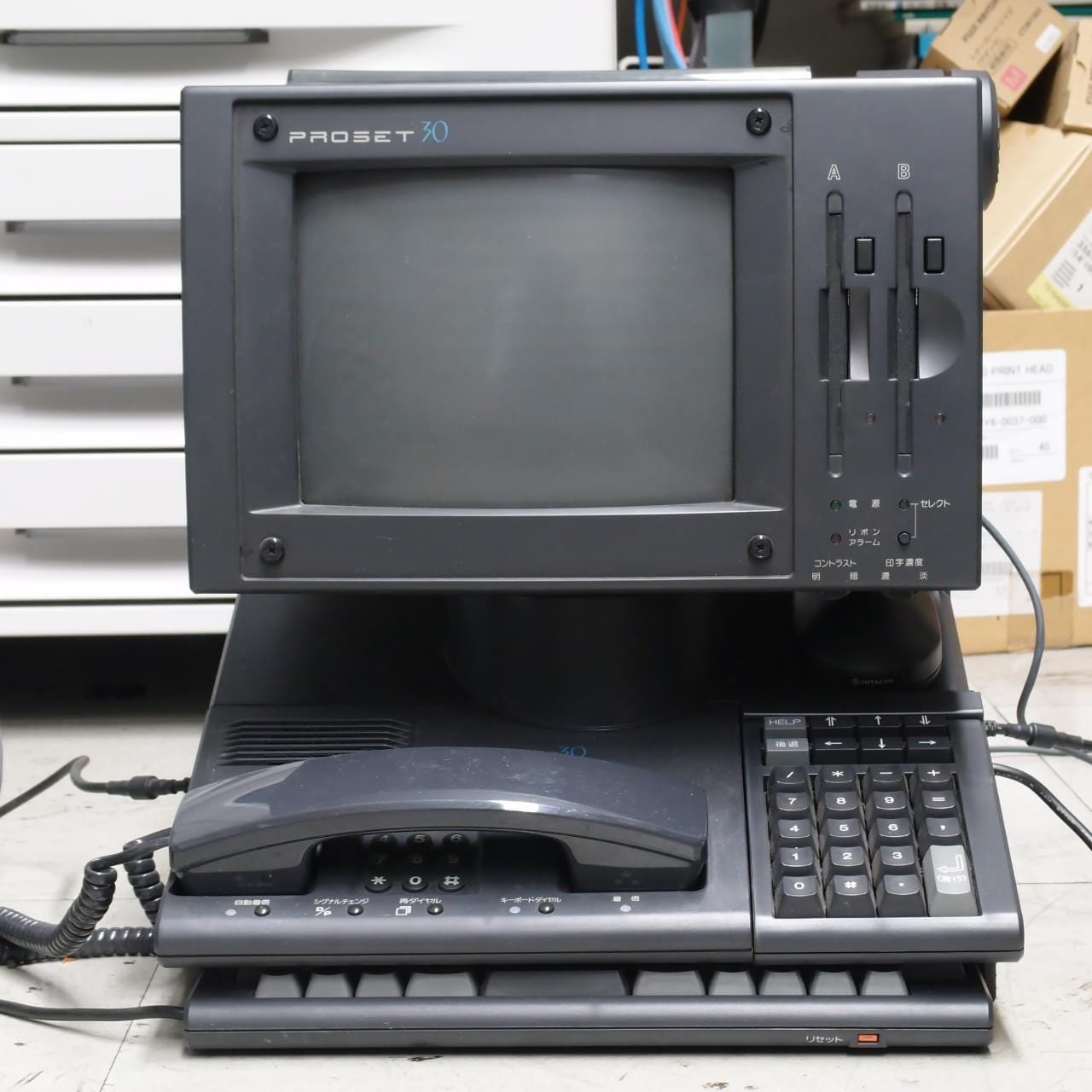
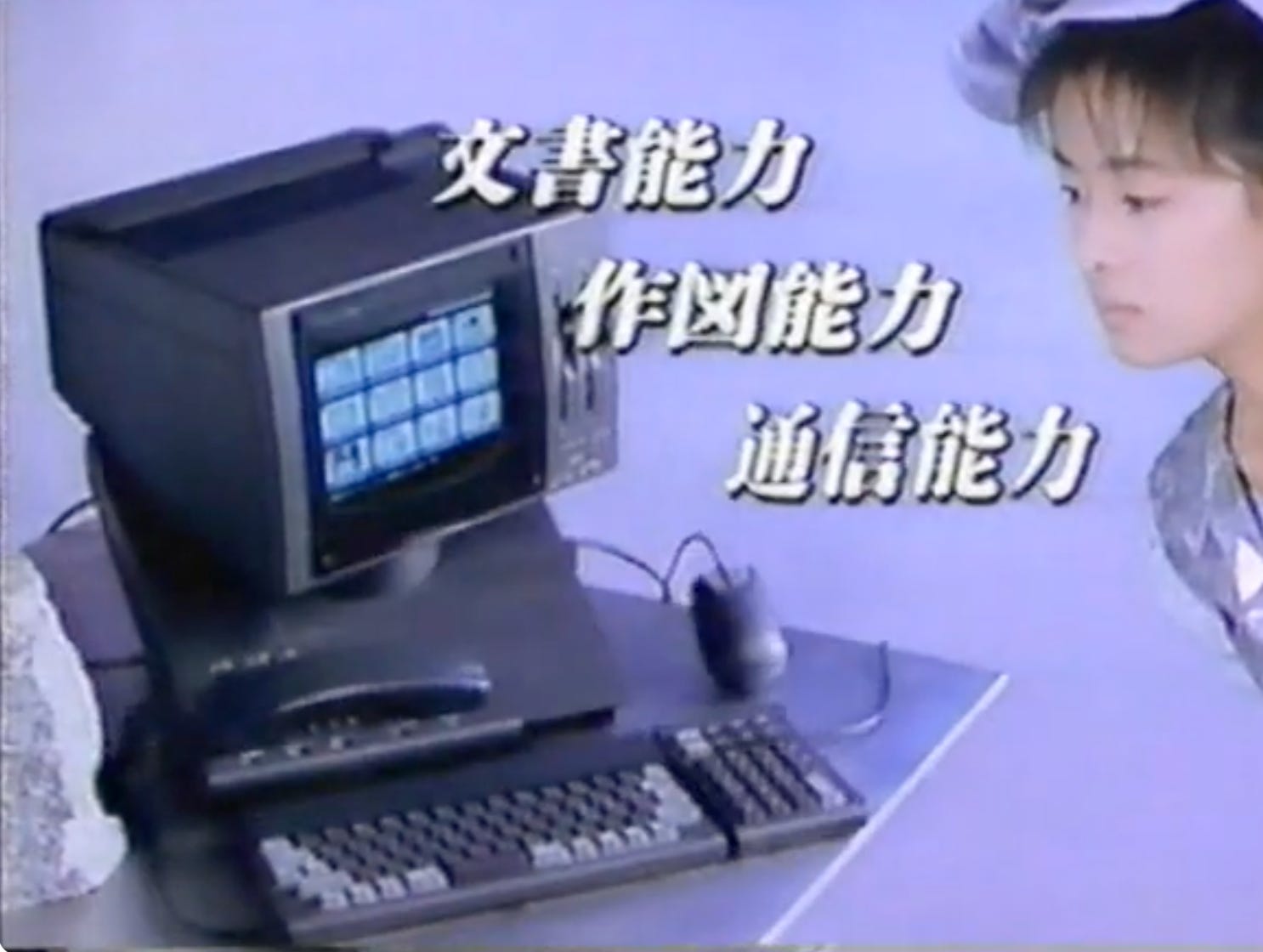
The Hitachi Proset 30 was built in 1989 and Hitachi called it a “personal work tool.” It was built around an 8MHz 80286, standard RAM was quite low at just 256K but it could be upgraded to 4.5MB. While the machine wasn’t generous with RAM, it did ship with a 40MB HDD, two 1.2MB FDDs, a 640 by 400 color CRT, SCSI, RS232C, modem, telephone, keyboard, and a mouse. As one might guess by these specifications, the machine was oriented around word processing, drawing, email, phone, and fax. Its OS did allow for window switching, and it came with software for the capture and display of still images.
By 1990, Hitachi had been around for eighty years, they’d entered many industries, and their computing division had developed everything from supercomputers to portables, and their TV division had made some home micros. Notably, Hitachi fabricated their own chips, and they had some good history with fabrication. Their CMOS process was as good as any competitor, and their vertical integration assured them supply of almost all of the components they’d require for any endeavor. The company was well known and well positioned for the competition of the 1990s.
My dear readers, many of you worked at, ran, or even founded the companies I cover here on ARF, and some of you were present at those companies for the time periods I cover. A few of you have been mentioned by name. All corrections to the record are sincerely welcome, and I would love any additional insights, corrections, or feedback. Please feel free to leave a comment.